
Whale Shark

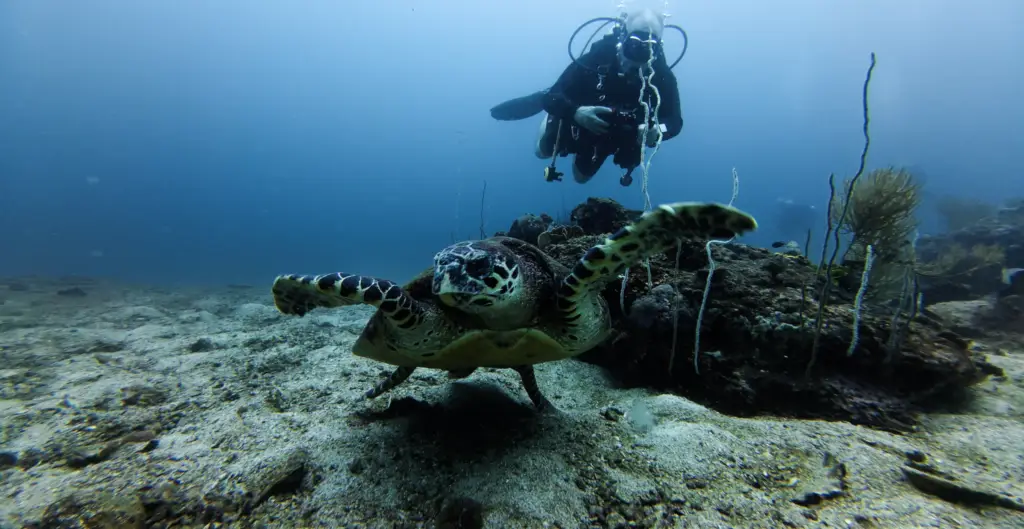
hawksbill turtle

Marine Life

Marine Life Fun Dive Package Dive Boats Diving on Koh Tao Chumphon Marine Park MARINE LIFE Chumphon marine life is diverse and impressive. Vibrant corals, colourful fish, cruising turtles, and the possibility to dive with a whale shark. With calm seas and clear waters for most of the diving season, there is much to see. Whether you join us for a PADI course or fun diving trip, you’ll get to explore some beautiful dive sites. Our experienced team of Instructors and Dive Masters know where to find all the best marine life in the Chumphon Marine Park, and will make sure you get to see as much as possible. In general, our divers are interested in four different categories of marine life: ●  Our corals – Without which Chumphon marine life would be nowhere near as varied and spectacular. ●  The big stuff – Whale sharks and other large marine creatures like turtles and passing rays. ●  Fish – Brightly coloured fish of all shapes and sizes have made the Chumphon Marine Park reefs their home. ●  The small stuff – For some divers, finding new nudibranch or minute crustaceans in the cracks and crevices is what it’s all about. Marine Life OUR CORALS Corals are the unsung heroes of our tropical ecosystem. Without the corals, there’d be way fewer fish to look at, and the dive sites would be much less colourful and awe-inspiring. Corals form the very foundation of the reef on which all other life forms thrive. Corals are typically separated into two varieties: hard corals and soft corals. Hard corals include boulder coral, brain coral, staghorn coral, and table coral. Soft coral species include whip coral, fan coral, bubble coral, carnation coral, sun coral, and cup coral. Our Corals THE BIG STUFF Sharks are a major attraction on every diver’s bucket list. For many, the chance to swim with a whale shark is the ultimate diving holiday experience. Whale sharks are more common at Chumphon dive sites than on Koh Tao and can be seen regularly, although the best time is usually between March and June. Other shark species can also be spotted cruising the marine park, as can several turtles and a few different species of stingray. The Big Stuff THE SMALL STUFF If you’re a macro lover, then Chumphon dive sites will not disappoint. If you take your time and look closely during your dives, you’ll be rewarded with some great finds. Keep a look out for nudibranchs on the reef walls and critters like shrimp, crabs, and octopus hiding in the cracks and crevices of the inner reef. ​ Whatever time you visit, and whether you choose to dive only in Chumphon or book a package that also includes diving on Koh Tao, we’re sure that you will leave with spectacular underwater memories that last a lifetime. If you’re planning your trip around specific marine life sightings, be sure to let us know in advance so we can help you arrange the best possible schedule. The Small Stuff OUR FISH There is an abundance of resident fish in Chumphon Marine Park, comprising both reef dwellers and pelagic species. Common sightings of reef fish include butterflyfish, angelfish, bannerfish, parrotfish, groupers, anemonefish, lionfish, pufferfish and filefish. Schooling pelagic species include snapper, barracuda, jackfish, and even the occasional swordfish. Our Fish
Marine Life Read More »

koh tao thailand

Dive Sites

Chumphon Dive Sites Marine Life Dive Boats Diving on Koh Tao Chumphon Marine Park Chumphon dive sites comprise coral reefs, small islands, and wrecks. All are home to an array of vibrant marine life, including whalesharks, turtles, and an abundance of tropical fish. Chumphon marine park is extensive but only sees a fraction of the underwater visitorscompared to other popular locations for SCUBA diving in Thailand.With over 40 separate islands and thousands of species of marine life, dive sites within Chumphon Marine Park have long been embracedby the local Thai diving community. Now becoming more popular with the broader SCUBA diving community, Chumphon dive sites arewaiting to be explored by both new and experienced divers on PADI courses and fun diving trips.Far from a secondary diving destination, SCUBA diving in Chumphon is as good as diving on Koh Tao – only without the hordes of otherscuba divers. The reefs are spectacular, and each dive site has its own distinct characteristics. So if you’ve been diving on Koh Tao andenjoyed it, Chumphon dive sites will not disappoint. Koh Ngam Yai Best Times: February – October Koh Ngam Yai is the larger of two island formations located just 17 kilometres off the coast of Chumphon. The underwater landscape consists of limestone with sparse vegetation amidst the natural, almost artistic, rock structures. Truly one of the best Chumphon dive sites, Koh Ngam Yai is popular with both SCUBA divers and snorkellers and is considered one of the most famous spots in the Gulf of Thailand for both activities. The colourful corals are home to many fish species, and the mild currents and exceptional visibility make it a firm favourite for Sensui Dive Resort customers. Hin Pae Best Times: February – October Hin Pae is located north of Koh Ngam Yai and is a unique dive site formed by an assembly of rocks that barely protrude the surface. The main point of interest is provided by the wreck of a Thai shipping vessel that sunk in a storm a few years ago. Since sinking, the ship has been slowly disassembling, with various parts finding new homes scattered across the reef. The maximum depth is 24m, but 10-15m is usually the optimum depth. Hin Pae is abundant in sea anemones, black corals, sea whips, giant clams, butterflyfish, barracuda, stingrays, turtles, and even whale sharks are spotted occasionally. Koh Ngam Noi Best Times: February – October Koh Ngam Noi lies 400 meters south of Koh Ngam Yai. It is only a third of the size of its sister island but very alike in its beauty. The best diving spot is at the southern tip, where there is a naturally formed swim-trough. Most divers stay close to the rocks as this is one of the best Chumphon dive sites to search for different types of nudibranch. Schools of fish include snappers, jackfish, and yellowtail barracuda, and blue-spotted stingrays can often be spotted on the sand. HTMS Prab 741 Wreck Best Times: February – October The vessel was commissioned in 1944 and was originally designed by the US Navy for Pacific island-hopping campaigns in World War II. In time, it was handed to the Thai Navy and used as a training vessel before being decommissioned. The ship was donated to Chumphon Province in 2011 for use as an artificial reef, and is now considered one of Chumphon’s best dive sites. The HTMS Prab lies at a shallow depth giving PADI Open Water divers easy access. A variety of marine life can be spotted, including large schools of one-spot snapper, fusiliers, and even the occasional hawksbill turtle or whale shark. Hin Lak Ngam Best Times: February – October Koh Hin Ngam is a small island of polished black volcanic rock formed by the ebb and flow of waves hitting its walls for thousands of years. It is located 2.5km south of Koh Ngam Noi and comprises two rocky outcrops. The maximum depth is 20m, visibility is usually good, and currents are mild. This dive site is well known for its healthy corals, including staghorn, table, brain, cabbage, and black varieties. Barrel sponges and anemone beds surround the island, and resident fish species include triggerfish, pufferfish, porcupinefish, and Moorish idols. Sam Laem Best Times: February – October This dive site gets its name from the three large rock pillars which have formed underwater in the shape of a triangle. Sam Laem, meaning ‘triangle’ in Thai, has a maximum depth of around 30 metres, and visibility is typically around 20 metres. This makes it an excellent option for fun divers who want to explore a little deeper, or students on PADI Advanced Open Water courses or Deep Specialty dives on the PADI Master Scuba Diver course.

Dive Sites Read More »

Scroll to Top